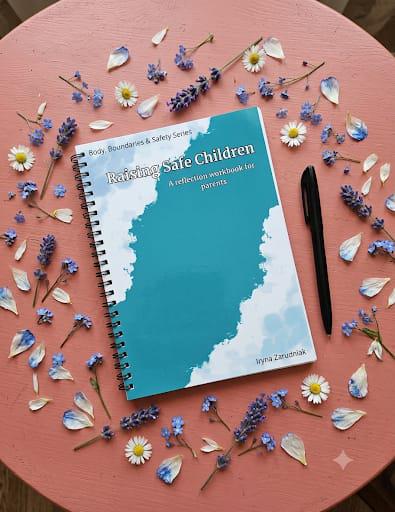
For parents of children aged 0–5
Raising Safe Children
Before you teach your child about boundaries, it helps to look at your own. 11 guided prompts and full lined pages to write on.
€ 8.00
Instant download · yours forever · no account
Format
Digital workbook (PDF)
Pages
17
Prompts
11 guided reflections
Works with
GoodNotes, Notability, or print at home
Most body safety resources give you scripts for your child. This one starts one step earlier — with the messages you absorbed about your own body.
The conversations start with you
You're not sure how you feel about your own boundaries
It's hard to teach a firm "no" if you're still working out how to say it yourself.
You don't know what messages you're passing on
The way your own body was talked about in childhood shapes what comes out of your mouth now — often without you noticing.
You keep putting off "the conversation"
You know it matters, and you still haven't found the moment — or the words.
What's inside
- 01
Part One — Your Own Story
How your body was talked about in childhood, and where you learned your boundaries.
- 02
Part Two — Your Child Right Now
The conversations you've had, and how your child already signals discomfort.
- 03
Part Three — Building the Conversations
What you want your child to know by age 5, plus a concrete action plan.
What you'll leave with
A clearer view of your own patterns
Where your own boundaries came from — and whether you want to pass them on.
A concrete action plan
Not just insight, but one thing you'll start saying or doing differently at home.
A resource to return to
There's no right order and no deadline — come back to it as your child grows.
Included
€ 8.00
Instant download · yours forever · no account
Questions about this guide
Do I need to be "good at" journaling?
No — there's no right order, no deadline, and no one reading over your shoulder. Answer one prompt a week or sit with the whole thing in one evening.
Is this instead of the guide, or alongside it?
Alongside it. This workbook is about you; the Body, Boundaries, and Safety guide is about the conversations with your child.
What if I don't have clear answers?
That's normal, and part of the point — some prompts are meant to sit with you rather than resolve immediately.
Can therapists or group facilitators use this?
Yes — it's also used as a between-session reflection tool.